Pip vs Heathcliff: Love or Obsession?

I feel as though the more I read of Great Expectations the more similarities I see between the main character Pip and the main character of Wuthering Heights, Heathcliff. While reading chapter 44 from this week’s reading one part in particular stuck out to me. It is the moment when Pip finally confesses his love for Estella. He says, “Estella, you know I love you. You know I have loved you long and dearly.” This immediately makes me think back to our reading of Wuthering Heights and how Heathcliff no matter what, continues to love Catherine. This is something Pip and Heathcliff have in common, they try to make themselves into gentlemen for the women they love and even though they know it might be impossible for them to be together, they continue to love them regardless. Although, it may sound endearing that these men will always love these women, I can’t help but think it seems to be a little more of obsession or infatuation than real love. A little later on in chapter 44 Pip says, “I know. I know I have no hope that I shall call you mine, Estella. I am ignorant what may become of me very soon, how poor I may be, or where I may go. Still, I love you. I have loved you ever since I first saw you in this house.” It seems to me that Pip is just ponding over Estella even though he knows she’ll never love him back. Even still, his love for her is overpowering and he feels the need to express his feelings for her, no matter how desperate he seems. In Heathcliff’s case, he knows Catherine loves him but because of social and economic reasons and perhaps even her own selfish reasons, she decides to marry Edgar instead. It seems that both Estella and Catherine are women who have a powerful hold over men like Pip and Heathcliff and it causes them to act out in ways that might mean to be loving but in the end comes off as obsessive or neurotic.

Holding Their Oppressors Accountable: Pip and Catherine II

One of the connexions that I was particularly interested in was Pip’s condemnation of Miss Havisham’s duplicity and his hope that Estella will leave Drummle behind to Catherine II’s animosity and outrage concerning Heathcliff’s treatment of Hareton in Wuthering Heights. One of the things that I realised these two characters have in common is that they both have come to terms with the truth and want nothing more than to free their loved ones from the manipulation of their superiors. 

In chapter 44 of Great Expectations, Pip takes his newfound knowledge about his benefactor straight to Miss Havisham and condemns her for leading him on and coercing Estella into an unhappy marriage, for the sake of petty vengeance. This is precisely the same manner Catherine II forges her alliance with Hareton in Wuthering Heights. After having suffered directly from the hands of Heathcliff and has become accustomed to his cruel, tyrannical behavior, Catherine II implores Hareton to advance his station by informing him of the displacement that Heathcliff has caused him. Whether this is out of spite for Heathcliff, genuine love for Hareton, or perhaps a combination of both- Pip’s actions are directly informed by his infatuation with Estella. Interestingly enough, both Estella and Hareton react in the same manner- and while they acknowledge that they have been wronged, they do not hold their oppressors accountable. Estella claims that her marriage to Drummle is of her own will, her own doing and Hareton, on numerous occasions, chastises Catherine II when he believes her tone regarding Heathcliff borders disrespect or treachery. 

These parallels, among many others throughout Dickens’ novels, nonetheless makes me curious about the extent to which he was familiar with the tropes of Bronte’s novel, or whether or not these narrative techniques are normative for novels written during the Victorian era.

Ghosts in Wuthering Heights and Great Expectations

Wuthering Heights ends with a striking and iconic depiction of ghosts when a young boy perceives the spectral Heathcliff and Catherine upon the heath, roaming the earth together in an atypically active afterlife. Ghosts are referenced, though not explicitly seen, on numerous other occasions, for example, when Heathcliff visits Catherine’s grave and feels the oppression of her spirit upon him. In all, Wuthering Heights portrays ghosts as legitimate and active forces that are capable of presenting themselves within the physical world and who perhaps even reside within it.

An active ghost is also introduced in Great Expectations when Magwitch details his life story to Pip and Herbert. While glossing his experience working for Compeyson as a forger and counterfeiter, Magwitch mentions one of Compeyson’s “colleagues,” a man named Arthur, who was involved in a scheme with Compeyson to swindle a rich woman of her fortune. Herbert and Pip realize that this woman was Miss Havisham, making Arthur the man who left Miss Havisham at the altar. This realization is supported by the “haunting” that Magwitch experiences at the hands of Miss Havisham. Magwitch reports an instance wherein Arthur, in a cold sweat, claims that the ghost of Miss Havisham has presented herself to him “all in white…[with] white flowers in her hair” (Dickens 52) and appears “awful mad.” Perhaps most disturbingly, Arthur asserts that Miss Havisham’s ghost possesses a bleeding heart and has assured Arthur that he has broken it and caused its bleeding.

Compeyson replies to Arthur’s story by flippantly calling him a fool. “[D]on’t you know she’s got a living body?” (Dickens 52) he says, demanding that his wife go comfort Arthur and investigate the validity of the ghost’s presence. While Compeyson’s wife is trying to assuage Arthur’s fear, Arthur perceives the “ghost” of Miss Havisham yet again and begs her not to touch him with the ominous shroud she carries and resists her attempts to lift him up. However, the “ghost” of the jaded woman ultimately succeeds, as Magwitch recalls seeing Arthur lift himself up and die immediately after.

Thus, an interesting and complex parallel is drawn between the two novels. This parallel poses multiple questions that could be answered in a variety of ways. On one hand, both novels seem to be assigning agency to the deceased by citing instances of their intervention. However, Wuthering Heights takes care to grant validity to the phantoms, as they are only perceived by a character, the young boy, who himself does not bear the bias that the novel’s other narrators, Lockwood and Nelly, bear. On the other hand, Great Expectations creates a specter of a living soul. As Compeyson insensitively but correctly states, Miss Havisham is still living and therefore likely could not haunt Arthur without entering the premises physically. Indeed, Miss Havisham’s haunting of Arthur could be perceived as a figment of Arthur’s imagination and as a manifestation of his guilt over his actions. Furthermore, Arthur’s encounter with Miss Havisham’s ghost could be attributed to the state of decline that Magwitch perceives him to occupy.

Unlike Wuthering Heights, the legitimacy, or at least, the agency, of ghosts is questioned through the skepticism of Compeyson and through the apparent hand Arthur had in his own destruction, as Magwitch sees Arthur lift himself before passing away. However, in questioning the legitimacy of Miss Havisham’s ghost, another question is posed by Dickens. Is it possible that Miss Havisham, though living, was indeed haunting Arthur? It is undeniable that, due to the tragedy she experienced, Miss Havisham’s life is exceedingly extraordinary. Perhaps, somehow it is Miss Havisham’s broken and therefore “dead” heart that haunts Arthur.

It is in this way that both Wuthering Heights and Great Expectations validate the existence of ghosts that arguably exist as the outcomes of love and that demonstrate love’s omnipotence. Just as Catherine and Heathcliff’s love was powerful enough to unite them in an active afterlife, Miss Havisham’s heartbreak was powerful enough to allow her to physically haunt Arthur, despite her being still alive.
Jack and Heathcliff

Upon reading the remainder of “Great Expectations”, I couldn’t help but to compare the Jack with Heathcliff. To start, both the Jack and Heathcliff are of a wealthy status and use that high status to their advantage. It is evident in both of them in the way they treat others that they see themselves as superior. I think this notion is well exemplified in chapter 54, when Pip narrates, “in the infinite meaning of his reply and his boundless confidence in his views, the Jack took one of his bloated shoes off, looked into it, knocked a few stones out of it on the kitchen floor, and put it on again. He did this with the air of a Jack who was so right that he could afford to do anything.” This is said in paragraph 50 of chapter 54. I think it perfectly describes how Pip sees the Jack and how the Jack sees himself, which is similar to Heathcliff.

Class and Culture: Wuthering Heights and Great Expectations

As I had discussed in my comment for Tuesday’s reading, the ontology of gentility is a major topic within Great Expectations, and I think beyond Great Expectations, it is a major topic in Wuthering Heights as well. Naturally, the two characters that receive focus through this lens will be Pip and Heathcliff, and this is due not only because of their meteoric rise in class status, but in how they represent an aberrance in Victorian culture. To wit, Pip is born an orphan, and is accordingly perceived to be emblematic of a baser culture than those of a higher economic status. Pip’s upbringing is not dissimilar to Heathcliff’s, as Heathcliff is an orphan who is rescued and brought up into a higher class status (although he falls from this as well, but he still rises once more). However, the way these two intersect is not in the fact of their shared rise, but how the two rose. In this rise, an element of criminality is unmistakably mixed, and in each, the mix is different. As towards Pip, his benefactor is a criminal. But for Heathcliff, his criminality is of an altogether different sort, and is never explicitly stated. Such as that, the reader, through Nelly’s view, can read Heathcliff as having been a soldier, and since this is Victorian England, there is no mistake that his soldiering was of the colonial type. This is a different kind of criminality, one that is legally validated, but morally questionable. Again, these are not illegal practices, but they are distinctly separate from what the old money gentry would deem acceptable (even if they themselves had a hand in this honeypot). Such as that, both Pip and Heathcliff feel a certain isolation from the prominent figures of old school gentility in their respective spheres. Pip feels himself in isolation from Estalla, and Heathcliff feels himself in isolation from Edgar Linton, with both feeling less than and unworthy in comparison (although, their manifestations of these feelings are distinctly different). Of course, these are false constructions, as most money is unethical in its origin, but the culture that these two are surrounded by deems the old money acquirement of wealth far more moral than both Pip and Heathcliff’s, even if there is little actual difference. Thus, the intersection of class and culture in both of these books demonstrates how culture is used to create class distinctions between people who have the same materiality. I believe further that both of these books is noting the absurdity of this mask, as well as noting the moral hypocrisy that the culturally adept have in their own economic pursuits.

Estella in the Sea, Catherine in the Clouds

When Pip goes to see Miss Havisham and Estella presumably for one last time, he tells Estella once again about his love for her. She shakes her head at his confession and tells him that he will get her out of his head in a weeks time. To this, pip replies, “Out of my thoughts! You are part of my existence, part of myself” (Chapter 44, Paragraph 70). Pip has become so consumed with his love for Estella that he feels something is missing when she is not around. This reminds me of Wuthering Heights when Catherine tells Nelly that she is Heathcliff. The two are so intertwined that they are one in the same.

Further in Pip’s confession he remarks that he sees Estella, “on the river, on the sails of the ships, on the marshes, in the clouds, in the light, in the darkness, in the wind, in the woods, in the sea, in the streets” (Chapter 44, Paragraph 70). He is so in love with Estella that he sees all of the good things about her in the world around him. This also occurs in Wuthering Heights when Heathcliff is lamenting over Catherine. He is haunted by the natural world because he sees Catherine in the clouds and the trees as well. Both men are surrounded by the images of their loved ones which I think goes to show the depth (or obsession) of the love the characters have for one another.

Social Class and Crime and Punishment in Great Expectations

In this section of Great Expectations, I was shocked to feel badly for Magwitch. While he is a criminal, it seems like Dickens makes readers feel pity for him. We get background information about Magwitch in Chapter 42 after Pip asks him about his history. Magwitch basically was raised poor and uneducated. When he was younger he was caught stealing food because he was starving and was sent to jail and since then he has been, “tramping, begging, thieving, working sometimes” when he could and consistently in and out of jails. Magwitch shares, “‘May be said to live in jails, this boy.’ Then they looked at me, and I looked at them, and they measured my head, some on ’em,… and others on ’em giv me tracts what I couldn’t read, and made me speeches what I couldn’t understand.” It is clear that Wagwitch’s low social status and lack of education gives him a huge disadvantage in trying to stay out of prison. He is almost punished for being poor. We see this when Compeyson gets significantly less time in prison than Magwitch because he presented himself like a gentleman in court. This backstory on Magwitch on top of the fact that Pip now doesn’t know what will come of his own financial situation is reflective of the difficulty of escaping social class in this society. This reminds me of some of the poetry that we read at the beginning of the semester like “The Chimney Sweeper” and “England in 1819.” In “England in 1819,” the writer critiques the government for their poor treatment of the lower class in England. The poem goes, “Rulers who neither see, nor feel, nor know, But leech-like to their fainting country cling.” As a result of this negligence toward this class of people, they are left to suffer and with no hope of escaping their poverty. Dickens also seems to be critiquing crime and punishment in England. He does so through his depiction of Magwitch and Pip’s unstable financial situation.

children

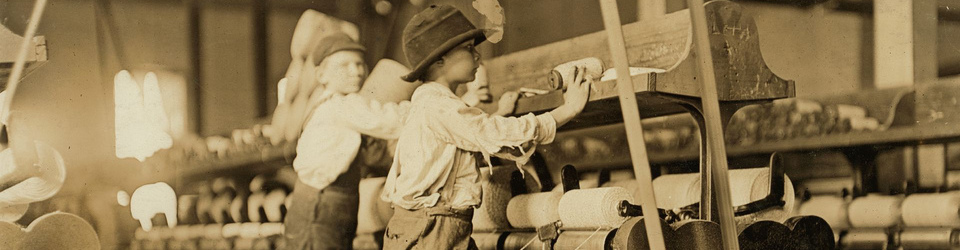
One connection I made is how Pip and the child factory workers in “The Cry of the Children” can be viewed as similar. Throughout the poem, images of a factory Hell are contrasted with the Heaven of the English countryside, the inferno of industrialism with the bliss of a land-based society. This is much like how Pip feels after he is introduced to Miss. Havisham and Estella’s lifestyle. Forced to learn the trade of a blacksmith he is miserable similar to how the children in the factories feel. They are both abused and work under poor conditions as well. Both of these works are told from the point of view of a child which also seems to be a reoccurring theme in Victorian literature. In “Great Expectations”, because the story is being told from Pip’s perspective, we have a more sympathetic view from young Pip and really feel and connect to his emotions much like the factory children in the poem. Although the works share some similarities, such as the abused child and emotional perspectives,  Pip is able to escape his fate unlike the children of the factory.

Love is an orphan

We gain insight from orphans throughout a series of texts such as; “Great Expectations”, “Wuthering Heights”, and “The Chimney Sweeper”. What each orphan has in common is the lack of love they receive from their love interests and/or even their adopted families. I choose to include “The Chimney Sweeper” because I remember in class, one of my peers mentioned that because the child was dying slowly from the harsh labor and pains they were going through, and calling out for their parent’s whose whereabouts were unknown, that the speaker’s parent might be in heaven as the poem does include a lot of religion remarks. It also makes the readers think about how a parent could ever let their child do something dangerous while they are off doing who knows what. In “Wuthering Heights”, Heathcliff is tortured by not only his adopted family but by his first and only love, Catherine. Catherine at first did not like him when he first came to live with her and her family, however, she had grown to love him up until she had stayed with the Linton’s, to where her personality changed and so did her feelings for Heathcliff. In “Great Expectations”, we see how Pip was raised by his sister Mrs. Joe and her husband, the blacksmith, Joe. Mrs. Joe was callous towards Pip and was abusive.

Pip and Heathcliff?

Each piece of literature we read from this time period, seems to always touch on social class and how it correlates to the characters. This seems to be a very important part the the development of each story and how the characters interact with each other. When reading this next section of Great Expectations we see another instance where a character of a different social class does not feel like he has the social right to interact or have a dignified relationship with a character of a higher social class. In chapter 43 Pip explains to the reader that he does not fit into the social class image that he feels like he needs to, to be good enough for Estella and her position in society. Naturally, this reminded me of Heathcliff in Wuthering Heights and how he did not feel as though he could belong in that higher social class either. I also found it very interesting that in each of these pieces of literature we see the same kinds of descriptions about each social classes. When Pip is speaking about Estella, he describes her as “Estella in her pride and beauty”, I saw a connection here with Catherine from Withering Heights. The characters of the higher social classes are always either described as beautiful, they have a certain image that they have to uphold. This led be to believe that this is why each of the characters, Estella and Catherine, are described in this manner. In Wuthering Heights, Catherine is described as being “changed” to fit into her class of society better. This connection shows us that there was a “social norm” for these social classes during this time. This is important for us to remember when reading literature from these times because we will be able to make this same connection amongst many other pieces of literature.