Mrs. Heathcliff: The Mischievous Woman

When we are first introduced to the master of Wuthering Heights and its residents, Mrs. Heathcliff (Cathy Linton) attracts the attention of Mr. Lockwood who initially mistakes her for Heathcliff’s wife, but later learns that she is the widow of Heathcliff’s son. Cathy’s behaviour in the beginning of the novel reminds me of a passage by Margret Fuller in George Eliot’s “Women in the Nineteenth Century” essay which states that when women are forbidden to enter the same spheres as men in regards to occupation because, “‘such things are not proper for girls,’ they grow sullen and mischievous.” In the interactions Lockwood observes Cathy in, first with Joseph and then with Heathcliff, he takes notice of her formidable character and fierce tongue. In her interaction with Joseph, who criticises her for her relation to Catherine Earnshaw and shames her for not being entirely lady like, her first impulse is to admit her connection to Catherine as a means which makes her a powerful woman, which is something typically frowned upon of in this period. In her interaction with Heathcliff, we see her instinct to defend herself with a witty, and often snide remark which Lockwood describes as “cat-dog combat.” Cathy has her mother’s fiery spirit, and while she has indeed grown sullen under Heathcliff’s harsh reign, she has also grown stronger and more mischievous than she ever was because the innocent Cathy Linton would not have survived a single day in the Heathcliff household. 

Characterizing the Genre: A Sample So Far

As I begin my first read of Wuthering Heights, I wanted to track back to previous texts I have explored, in order to do a check in on how I am painting my picture of the Victorian literature genre so far. The simplest solution: jotting down a list of traits so I can begin to pick up patterns between texts. The poem “England in 1819” by Percy Bysshe Shelley and the novel Wuthering Heights by Emily Brontë both possess grim characteristics. Shelley paints his poem with mud and blood –quite literally– in order to emphasize the hopelessness and despair of the kingdom. Likewise, Brontë begins the novel in a bleak and nasty storm followed up by a spirit haunting Mr. Lockwood, leading into him falling ill. These two samples of Victorian literature are illustrating dreary and dark elements, which reflects darker undertones of the genre as a whole. To tie in earlier examples, Carlyle’s “The Everylasting No” depicts elements of depression and frustration. Martineau discusses her frustration and displeasure at the political status of women. The four texts tackle very different issues: a poem about a massacre of civilians, a ramble about the negatives before a conversation, a political discussion on women’s rights, and a gothic novel. However, all of these texts dealt with hopelessness, frustration, and despair, and what three of them resulted in was hope. Carlyle’s “The Everylasting Yea” brought the positives after negativity and apathy, in Shelley’s poem it was hope itself illuminating the dark, and for Martineau, she ended her “Political Non-existence of Women” with a strong, hopeful reinforcement in the ‘consent of the governed’ as in all of the governed, men and women. Despite the hopeless beginning, perhaps what will be revealed in Brontë’s novel, is a hopeful ending. This would continue a pattern of starting and working within the grim and desolate, but ending up optimistic, which could be a formula for calculating the tone of future Victorian texts.

An analysis of how Nelly Dean embodies the themes of education influencing a woman’s relationships in Wollstonecraft and Fullers’ works.

When reading Wuthering Heights, I couldn’t help but draw a comparison between the relationships between men and women George Eliot (Mary Ann Evans) discusses in her critical essay on Margaret Fuller and Mary Wollstonecraft’s works of nonfiction and the way that Emily Bronte depicts the relationships between Cathy Earnshaw and her love interests: Heathcliff and Edgar Linton.  In her essay, Eliot writes that both Fuller and Wollstonecraft assert that “while men have a horror of such faculty or culture in the other sex as tends to place it on a level with their own, they are really in a state of subjection to ignorant and feeble-minded women”. In Wuthering Heights, the influence that Catherine Earnshaw has on Linton and Heathcliff is astounding. Bronte writes, “At fifteen she was the queen of the countryside: she had no peer: and she did turn out a haughty, headstrong, creature… She had a wonderful constancy to old attachments: even Heathcliff kept his hold on her affections, unalterably, and young Linton…” (Bronte 66). Wollstonecraft and Fuller’s books argued for an education of women that exceeded outside of household duties and was well versed in the arts, humanities, and sciences.

While Catherine Earnshaw displayed qualities of a strong, independent woman based on her own outspokenness and free will, she is also deprived of a real education: although as a lady her education is superior to Heathcliff’s, at the same time her education is limited to manners and the ritualistic Christianity she and her brother are taught by Joseph. Nelly Dean, to a certain extent, is not a reliable narrator. She asserts judgement on Catherine based on her actions, her emotions, and the control she has over her relationships. For example, when Catherine discloses her intention to marry Linton and then use his money to assist Heathcliff, Nelly says, “It only goes to convince me that you are ignorant of the duties you undertake in marrying; or else, that you are a wicked, unprincipled girl” (Bronte 83). Bronte seems to be using Nelly to insert the argument seen in Fuller and Wollstonecraft’s works, and further discussed by Eliot: that in order to succeed in marital relationships, a woman must be educated: not for their own benefit, but for the benefit of their spouse.

Hindley the Steam King

Certain parts of the poem “The Steam King” by Edwin Mead remind me of Hindley Earnshaw from Emily Brontë’s Wuthering Heights. While I am not claiming that Hindley is comparable to the Industrial Revolution itself, there are certain parallels that can be drawn from the poem and bits and pieces of Hindley’s character.

In the poem, the Steam King is considered a tyrant, much like Hindley has become, especially after the death of his wife. The line “his bowels are of living fire, and children are his food” (11-12) reminds me of Hindley’s abuse towards Catherine, Heathcliff, and especially his own son whom he throws over a bannister in his drunken rage.

Finally, “the sighs and groans of Labour’s sons are music in their ear…” (21-22) reminds me of how poorly Hindley treats those he deems underneath him including his servants and especially Heathcliff.

However, the ending of the poem calls for “right” to prevail and ultimately the downfall of the Steam King. At this point in the book I’m not sure if there is hope for Hindley to change or mend his ways, but I’m rooting for him!

How Catherine’s ghost relates to the past

The complex histories and connections to the past these first few chapters describe paired with the appearance of Catherine’s ghost made me wonder about what the novel is trying to say about connections with the past. The scene in which Lockwood encounters the ghost is ambiguous, Lockwood had been dreaming leading up to the encounter and it is not clear to the reader if what he is experiencing is real or another dream. I think this ambiguity adds to the deeper meaning behind the desperation of the figure of Catherine. The stories Lockwood is told about the history of Wuthering Heights and its inhabitants have a melancholy feel. Even the way the physical setting is described invokes an unsettling feeling. Which is mirrored in the appearance of Catherine’s ghost and also in the different poems about child labor we read for last class. In “The Chimney Sweeper” there is a line that reminds me Catherine’s plea to Lockwood, “A little black thing among the snow/Crying weep, weep, in notes of woe!” this is describing a child lost in the starkness of the snow crying because of the labor he is forced to preform. This image coupled with the image of Catherine gives me the same feeling. Desperation. The line that she speaks even echos the child’s weeping, “…but the hand clung to it, and a most melancholy voice sobbed, ‘Let me in—let me in!” I am looking forward to seeing how this theme of melancholy and the past develops as we learn more about these characters and their stories. Right now i would predict that the ghost represents the characters unwillingness to let got of their trauma and cope with life after tragedy so this leaves them in a perpetual state of unrest and sadness.

Contrasting Stereotypes of the 18th Century

Catherine Earnshaw is one character who I am so intrigued by. She has this independence quality to her which defies certain aspects of Victorian stereotypes during the 18th century. Interestingly enough, Wuthering Heights provides a great contrast between gender roles and stereotypes.  As my group had to do the research for this weeks discussion, we found a great article that touches on feminist and marxist theories in the novel. One of these aspects we researched is how women were forced into a role to transform themselves and fit other roles that may not be themselves, all for a man. She transitions from a rebellious daughter to a delirious wife character all to fill identities that are basically assigned to her. This touches on a theme we have talked about in class. Women are forced into these submissive roles in order to fulfill an ideal of their gender. Catherine specifically, shows this dynamic character. It is just clear gender roles is a great theme that seems growing in our discussions. In relation to other texts we touched on, specifically the connection to gender equality, it made me think of Carlyles Democracy, as Carlyle takes a superior role over women. This male dominance is conveyed in Wuthering Heights, however, it has kind of a conflicting comparison. At some points the roles seem reversed in a way. Regardless, Wuthering Heights brings up great analytical aspects to masculine and feminine characteristics during the victorian era. Martineau’s Society in America brings up great contrasting points to the same aspects. Specifically, how Martineau expressed her views on women rights. We spoke about how it was uncommon for women to express their grievances in general during this time period, so Martineau challenging that norm is a great connection here. I see the same connection with Catherine as she seems to challenge her role at times. Lastly, Mary Wollstonecraft compares women and their relationships with men to a “doll-Madonna” which further sheds light on women acting as a doll, transforming into a role solely for others. 

Connections between Readings

When reading the first couple of chapters for Wuthering Heights I continue to see that same abuse of power that we see in so many other readings. Nelly begins to recant the stories of everything that has gone on in Wuthering Heights and our eyes begin to open to all the things that were going on prior to the time period of the book. I see this most prominently when Hindley is able to get away with treating Heathcliff the way he does since he is in authority or of a higher social class that Heathcliff. We tend to see this happening very frequently and it comes up as a common discussion in class. I also thought of another slight connection to our discussion of Queen Victoria in relation to our readings about Carlyle. This situation is similar to how Queen Victoria took in a child of a low social class. It reminded me of this, however it is clearly very different because Queen Victoria treated her god-daughter like her own, since she was so smart. Hindley knows that no one will question his treatment of Heathcliff because of his position in society. This is why the greed and power theme is always reiterated in my head while reading Victorian Literature, because everyone in higher society or simply a position of power had a sense of that.

While reading about how young Catherine was changing due to the people she was surrounding herself with I was thinking about George Eliot’s essay. Woman are always expected to act a certain way and keep a certain type of company. I was making this connection and thinking about the premise of the paper and how women should be able to do anything and not be held to a certain standard that is drastically different from the one created for men.

When thinking back to the treatment of Heathcliff I recall he was being treated different because he looked different and was different from everyone else. He was not allowed to play with the same children as Catherine. Instead of being treated like he was apart of the family, he was being treated as a “worker”. This brings me back to the discussion we had about how what you wear and your appearance carried such weight, especially in this time. Heathcliff was excluded and not treated fairly as a child, simply because of the way he looked and dressed.

Wuthering Heights (Chap. 1-9) — Make A Connection

To begin, enter Mr. Lockwood, a new tenant of Mr. Heathcliff. Their relationship is not at all the best and you can feel the tension between the two. Mr. Lockwood, upon his arrival, meets Nelly, one of the servants at the Wuthering Heights manor. After his supernatural encounter with that of a ghost named Catherine, he becomes frightened and asks Nelly to explain what happened in this house. Nelly goes on to tell him the story of Heathcliff and his family. Heathcliff, a dark-skinned gypsy, who was picked up by Mr. Earnshaw and was resented by Catherine, Hindley, and Mrs. Earnshaw. Although, after a time, Catherine grew to the likings of Heathcliff, Hindley and Mrs. Earnshaw remained to be cruel and upset towards Heathcliff being a part of the family.

Reading this reminded me of two different things we discussed in class. One being Thomas Carlyle’s Sartor Resaurtus when he talks about social class and how even just the clothes you wear determine what position or role you take up in this society. Being a dark-skinned gypsy in this era happened to be the worst possible class you can think of. Later on, in his years, Hindley returns with his new wife, after his father’s death, only to inherit their home. He seeks his revenge on Heathcliff by denying him his education and making him a servant. In other words, he made him his slave. We come across more racism within other characters and even Catherine herself who was his only companion, after spending some time with the Linton’s. The second connection I made towards this was the article that one of the groups had discovered where a Queen (Higher class/ Royal class) had taken in a young black girl by the name of Sarah and she paid for her education and made her, her goddaughter. This is similar to Wuthering Heights because Mr. Earnshaw, despite the racial differences within this era, brought in Heathcliff to his manor and gave him shelter, food, and love.

The Rejection of Structured Spirituality through Romanticism

One of the earliest discussions I can recall from this class is that which was ruled by our attempts to find a definition for Romanticism, the literary movement that dominated the first half of the Victorian period. The need for a definition of this literary movement arose from our conversations surrounding Thomas Carlyle’s Sartor Resartus and its apparent rejection of traditional Christian spirituality. Indeed, while Carlyle’s text featured a fair amount of language typically associated with Christianity, what with his frequent allusions to the devil, his work ultimately argues that the only remedy to the tremendous sense of doubt that Teufelsdröckh feels is to access the spirituality that resides inside oneself and one’s natural environment. Teufelsdröckh ceases to view the universe as one great, big dead machine and begins to locate the divinity within himself, as is witnessed in the “Everlasting Yea” section of Sartor Resartus and further observes the divinity of nature in “Natural Supernaturalism.” Thus, Carlyle’s work embodies a Romantic conversion as opposed to a Christian conversion, due to Sartor Resartus’ structural path from a negative ideological pole, to a neutral center, and finally to a positive ideological pole. According to Walter L. Reed, this form correlates with the structure of a so-called Romantic conversion. Additionally, the work aligns with our class’ definition of Romanticism and can arguably be categorized as such. Indeed, Carlyle’s commitment to aiding his readers in their search for spirituality within themselves and within nature identifies Sartor Resartus as an excellent example of Romanticism, or at least, as an undeniable precedent to the genre.

Similarly, Emily Brontë’s Wuthering Heights, even in its earliest pages, rejects and critiques traditional Christian spirituality in favor of Romantic spirituality, that is, one that is found and fortified by the self and by nature. Firstly, Brontë, in her characterization of Joseph, Heathcliff’s servant, creates a deft critique of Christianity. She does so through her authorial decision to embed Joseph’s dialogue with long-winded references to scripture and with hypocritical moral lessons grounded in Christian thought. Indeed, Catherine Heathcliff even refers to Joseph as a hypocrite in chapter two, an idea founded upon Joseph’s lack of care or concern for others and that cements the hypocrisy within much of his discourse and behavior. Furthermore, Brontë’s passionate, free-spirited heroine, Catherine Earnshaw, embodies the Romanticism that pervades Brontë’s novel. While confiding to Nelly, Catherine claims that “heaven did not seem to be [her] home and [she] broke [her] heart with weeping to come back to earth; and the angels were so angry that they flung [her] out into the middle of the heath on the top of Wuthering Heights; where [she] woke sobbing for joy.” (Brontë, 25) This quote from Catherine shows that Brontë’s novel rejects Christian tenets of spirituality, as is shown through Catherine’s unhappiness with the Christian idea of heaven and through her love and reverence for Wuthering Heights, the environment in which she was raised and to which she was so attached. Therefore, it can be argued that Brontë’s novel and Carlyle’s Sartor Resartus each strongly adhere to the Romantic theme of locating spirituality within the individual and within nature, as opposed to gleaning spirituality from rigid Christian concepts.
The Mistreatment of Children By Familial Figures

While reading the first few chapters of Wuthering Heights, I was drawn to the treatment of Heathcliff by his new “family” throughout his childhood. Everyone except for Catherine and Mr. Earnshaw don’t seem to like him very much. When he is first introduced to the family as an orphan brought home by Mr. Earnshaw, Nelly says that she was scared by him and how dirty he appeared, repeatedly referring to Heathcliff as an ‘it’, as though he were not human. She also recalls how Mrs. Earnshaw was ready to throw him back out onto the streets but Mr. Earnshaw thought that they should take him in. As Heathcliff grows older and Hindley takes over Wuthering Heights after Mr. Earnshaw’s passing, he then shifts into the role of a servant to the family and is no longer being educated. He had been mistreated all throughout his childhood by his “family” and they do not seem to notice that what they are doing to him is wrong because they do not see Heathcliff as being an equal to them.

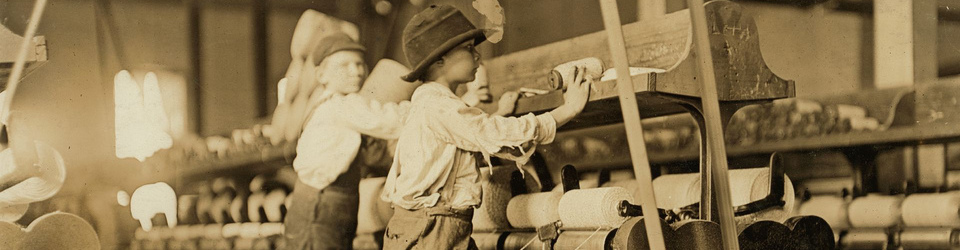
This brought me to think of the child labor poems that we read last week and the mistreatment that the children in these poems also faced by their family, specifically in “The Chimney Sweeper”. In this poem the child that the poem is speaking of is referred to as “a little black thing”. This is also an example in which a child is dehumanized. The child is asked where their parents have gone, to which they reply that they have left them and gone off to pray. In the next stanza the child explains how they ended up in this situation as a chimney sweeper. It seems as though their parents thought they were happy as a chimney sweeper so they continued having them work, however it has made them miserable and they feel they are on their way to death. The child then describes how the father and mother do not seem to think they have done anything wrong in sending them off to be a chimney sweeper because the State and church have not said that what they are doing is wrong.

In both of these instances children have been mistreated by their families as a result of social standing. In Wuthering Heights, it is as though Heathcliff was never able to leave his place as the poor orphan who had no where else to go, while in “The Chimney Sweeper”, the child is being endangered by his parents in order to help make more money.